The four marks
Turn the piece over. On the underside of a teapot, the back of a spoon stem, or the rim of a salver, there will be a short row of tiny stamped symbols. Each one was struck at an assay office after the metal had been tested, and together they form a legal record that has been kept in Britain since 1300.
The order varies by office and period, and pieces marked between 1784 and 1890 also carry the sovereign’s head to show that duty was paid. Read them in this sequence and the rest follows.
| Mark | What it tells you | Example |
|---|---|---|
| Standard mark | The metal and its fineness | Lion passant for sterling |
| Town mark | The assay office that tested it | Anchor for Birmingham |
| Date letter | The year, from the office’s cycle | Lower-case k in a shield |
| Maker’s mark | The sponsor who submitted the piece | PS for Paul Storr |
The standard mark
The lion passant, walking left with its right forepaw raised, has meant sterling since 1544: 925 parts silver in a thousand. The figure of Britannia means the higher 958 standard, which was compulsory between 1697 and 1720 and has been used by choice since. A 925 in an oval is the fineness mark used on imported silver after 1904 and on all British silver since the 1999 changes to the Hallmarking Act.
Scottish silver carries a thistle instead of the lion until 1975, and Irish silver a crowned harp. If you find none of these and instead see EPNS, EP, A1, or the words “silver plate”, the piece is electroplate. It has a thin layer of silver over nickel or copper, and no assay office ever tested it.
The lion is the mark that matters. Without it, the rest of the row is decoration.
Where it was tested
The town mark tells you which assay office struck the piece. It is not always where the object was made, but it narrows the maker’s register you need to search.
| Mark | Office | Years |
|---|---|---|
| Leopard’s head | London | 1300 to date |
| Anchor | Birmingham | 1773 to date |
| Crown, then a rose from 1975 | Sheffield | 1773 to date |
| Three-towered castle | Edinburgh | 1485 to date |
| Tree, fish and bell | Glasgow | to 1964 |
| Three wheatsheaves and a sword | Chester | to 1962 |
| Hibernia | Dublin | 1731 to date |
Exeter, Newcastle and York closed in the nineteenth century, and their marks turn up on Georgian pieces. Newcastle’s is three castles, York’s five lions on a cross, Exeter’s a triple-towered castle that is easy to confuse with Edinburgh.
The date letter
Each office ran through the alphabet one letter a year, changing the typeface and the shield shape at the start of every cycle. The same letter k appears in a dozen different years, so the shield and the style of the letter are what fix the date. Before 1975 each office had its own cycle; from 1975 all offices used the same letter in the same year, and since 1999 the date letter has been optional.
The table is the one part of this you cannot do from memory. The date letters guide explains how the cycles work, and the identifier carries the tables.
The maker’s mark
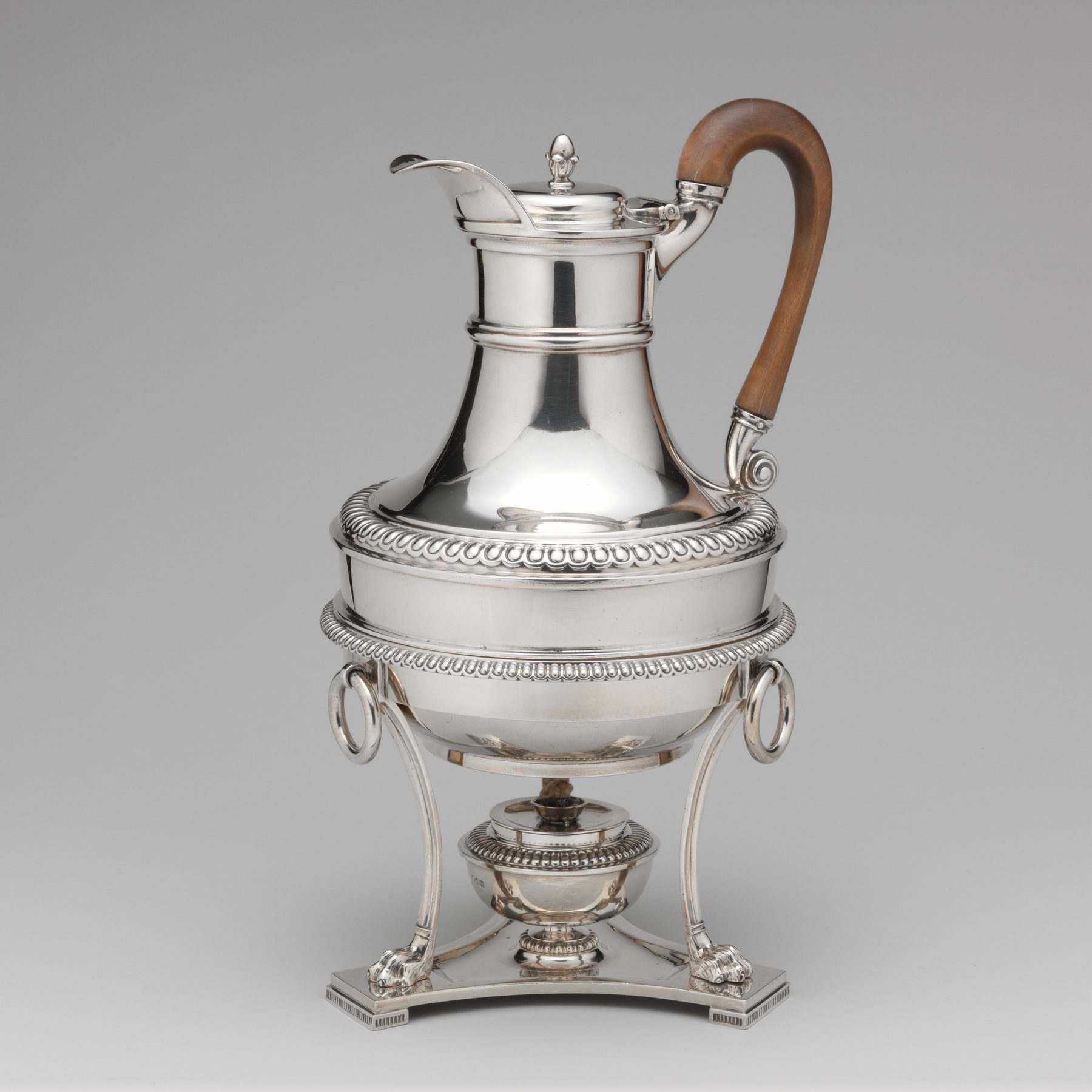
Initials in a punch, registered at the office by whoever took responsibility for the piece. The trade calls it the sponsor’s mark for that reason: the person who sent it for assay was not always the person who made it. On the Storr jug photographed above it reads PS. On a Birmingham teapot from 1889 it reads H&H for Hukin and Heath.
The register is where a good name doubles a price. The makers’ pages cover the names that matter most.
Duty marks and other extras
A sovereign’s head in profile means the piece was marked between 1784 and 1890, when duty was payable on silver. George III faces right, George IV and William IV face left, and Victoria faces left. It is a useful cross-check on the date letter.
Commemorative marks appear for the 1935 Silver Jubilee, the 1953 Coronation, the 1977 Silver Jubilee, the Millennium and the 2012 Diamond Jubilee. An F in an oval on pieces marked between 1867 and 1904 means foreign, and after 1904 imported pieces carry a distinct set of import marks.
What the marks do to the price
A plain Victorian teapot by an unknown Sheffield maker sells close to its weight in silver. The same form struck with PS and a London leopard sells for the name, and the gap is a factor of ten or more.
| Object | Marks | Hammer |
|---|---|---|
| Teapot, Sheffield 1889, unrecorded maker | Lion, crown, date letter | £180 |
| Teapot, London 1807, Paul Storr | Lion, leopard, date letter, PS, duty mark | £6,400 |
Both are illustrative figures from the price records. Before consigning anything, weigh it and check the scrap calculator, then check the maker.