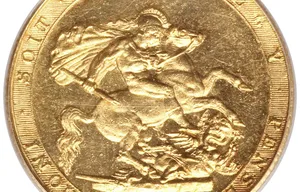
A crown struck from 1818 to 1989 is legal tender for 25 pence
The Royal Mint states the position plainly: at decimalisation the five shilling coin, or crown, was redenominated as a 25p coin, and pieces struck before 1990, back as far as 1818, remain legal tender for that amount. New issues from 1990 carry a face value of £5 instead, set to suit the weight and size of the coin. So a Churchill crown is 25p and a crown of the same diameter struck after 1990 is £5, and the Mint notes that banks and retailers are not obliged to take either, that most refuse, and that the Post Office has agreed to exchange them for goods and services.
That 25p is the floor under a crown struck from 1947 to 1989, because none of them holds silver. The crowns worth more than their face value are the ones struck before 1947, which hold metal, and the few early dates a collector wants in high grade. Everything in between is a souvenir, and it was sold as one.
The coin that never managed to circulate
The crown spent four centuries failing at the job of circulating. The Royal Mint Museum’s account of the crown dates the first gold crown to August 1526 at four shillings and sixpence, superseded in October of the same year by one worth five shillings. Edward VI issued a large silver coin of five shillings in 1551, which took the gold coin’s name, and the two were struck side by side until the gold crown ceased early in the reign of Charles II.
By 1751 the silver crown’s popularity had declined and it played a limited role in circulation. The revival of 1818 put Pistrucci’s head of George III with his St George and the dragon on a coin the museum calls one of the handsomest in Europe, and it still failed to re-establish itself, as a second attempt at the end of the century also failed. Its size then made it useful for something else, and the Royal Mint dates the crown’s life as a commemorative coin from 1935.
Two consequences follow for anyone holding one. A crown that was bought as a keepsake was rarely worn, so condition separates these coins far less than it separates a half crown out of a till. And the ones struck for royal occasions were struck in millions, because millions of people wanted one.
Three standards, and the silver in one crown
The crown weighs 28.28 grams and measures 38.61 millimetres, figures the Royal Mint still publishes for today’s £5 coin, which has kept the size of its predecessors. The recoinage of 1816 struck silver at 66 shillings to the troy pound, which makes a five-shilling piece five sixty-sixths of a troy pound, or the same 28.28 grams. The silver inside that weight changed twice. The column below gives the standard in force rather than years in which crowns were struck, because the denomination went long stretches with no issue at all.
| Standard in force | Standard | Fine silver in one crown |
|---|---|---|
| 1816 to 1919 | Sterling, 925 | 26.16 g |
| 1920 to 1946 | Half silver, 500 | 14.14 g |
| 1947 onwards | Cupronickel, no silver | None |
The Coinage Act 1920, dated 31 March 1920, put the 500 standard in place of the sterling wording in the schedule to the Coinage Act 1870, for coins made after it came into force. The Coinage Act 1946 then provided for a coinage other than silver, and its schedule sets the crown at 436.36363 grains, or 28.2759 grams, of three-quarters copper to one-quarter nickel. Neither change shows in a design, so the date is read first. Price the metal against the London benchmark rather than any figure printed here: the silver price page gives every standard by the gram, 500 among them, and the old coins guide carries the melt arithmetic for each pre-1947 denomination with what a refiner and a dealer pay against it.
The dates in the drawer, and what settles each one
| Date | What it marks | Metal | What settles the price |
|---|---|---|---|
| 1887 to 1892 | Victoria’s Jubilee Head, by Joseph Edgar Boehm | Sterling | Date and grade. The Royal Mint records the design being criticised for the small crown on the Queen’s head |
| 1893 to 1900 | Victoria’s Old or Veiled Head, as the Royal Mint’s historic crowns listing bands them | Sterling | Date and grade |
| 1902 | Edward VII | Sterling | Grade, over a floor of 26.16 grams of fine silver |
| 1927 to 1936 | The wreath crowns of George V, named for their reverse | Half silver | Scarcity by date. This page carries no mintages, so a wreath crown is a question for a specialist rather than a price list |
| 1935 | George V’s Silver Jubilee, Percy Metcalfe’s stylised St George | Half silver | Grade, and nothing else. Struck in quantity, so only an unworn example carries a premium |
| 1937, 1951, 1953 and 1960 | George VI’s new coinage, the Festival of Britain, the Coronation of Elizabeth II, and the 1960 New York Exhibition crown. The Royal Mint’s note on the 1951 coin has it as one of only two crown types of George VI’s reign | Half silver in 1937, no silver after the 1946 Act | Whether the original case, envelope or set survives with it |
| 1965 | The death of Churchill | Cupronickel | Nothing. Close to 20 million were issued |
| 1972 and 1977 | The Silver Wedding and the Silver Jubilee, both by Arnold Machin | Cupronickel, and the Royal Mint lists a silver proof of the 1977 coin as well | Which of the two versions you hold |
| 1980 and 1981 | The Queen Mother’s 80th birthday and the wedding of the Prince of Wales and Lady Diana Spencer, issued as 25p coins | Cupronickel | Nothing beyond the 25p, unless the original packaging survives |
| 1990 onwards | Royal and national occasions, at £5 | Cupronickel, with precious metal collector versions | The packaging, and little else |
The Royal Mint calls the 1935 jubilee crown its first commemorative coin, records that George V was unimpressed with Metcalfe’s stiffly posed St George and called him “a damned bad rider”, and notes that a very small number of the coin were struck in gold alongside the silver. A gold 1935 crown is a different object from the coin in the drawer and belongs in front of a specialist before anything else happens to it.
One confusion is worth naming here. The 1937 crown is widely called a coronation crown, but the Royal Mint Museum’s account of new coins for a new monarch records that it was only with the crowning of Elizabeth II in 1953 that the Coronation was specifically referred to on a coin struck for the event. The 1953 crown carries Gilbert Ledward’s equestrian portrait, with a reverse by the herald painter Edgar Fuller modelled by Cecil Thomas, and the museum holds the rejected first version of that reverse, abandoned for being too crowded.
What a Churchill crown is worth, and the twenty million
The single most asked-about British commemorative is also the least valuable. The Royal Mint Museum’s entry for the Churchill crown records that it went on sale in October 1965 and that close to 20 million were issued by the following summer. Oscar Nemon’s reverse portrait, taken from a marble bust, was the first instance of a British coin carrying a portrait of anyone other than the monarch.
One variation exists, and the museum holds it. Its illustrated coin carries the artist’s initials in tiny letters to the left of the portrait, and the museum records that the decision was taken to remove them from the approved coins. The initials are not on the twenty million. Whether a coin carrying them is worth more than one without is not something the museum says, and this page has no result to quote for it.
What the records hold, and what the case is worth
The site’s price records carry a Victoria 1887 Jubilee Head crown in extremely fine condition, estimated at £80 to £120 and sold for £95 at hammer, and an Elizabeth II 1953 proof set in its case at £70. Both are illustrative figures rather than particular sales. The second is the useful one, because the museum’s account of the 1953 coinage records that the proof set contained the Coronation crown alongside the circulating denominations from halfcrown to farthing, and about 40,000 sets were made between September and December of that year. The crown out of that set, loose in a drawer, sells as a single coin rather than as the £70 lot.
The table above is the dates people write in about rather than every crown ever struck. A crown dated before 1887, such as George III’s of 1818 to 1820 or George IV’s of 1821, is priced by type, date and grade rather than off any table.
So the sorting for crowns is not the sorting for a jar of change. Pull out anything dated before 1947, which holds metal, and anything still in its original card, plastic envelope or Royal Mint case, which sells as what it was issued as.
Then weigh the large coins before calling any of them a crown. The large Victorian coin mistaken for one is the double florin, a four-shilling piece the Royal Mint records being added to the currency in 1887 as part of the Golden Jubilee coinage. A crown is 28.28 grams new and a little under that worn; at four shillings to the crown’s five, a double florin is 22.62 grams, a gap no amount of wear explains, and the half crown guide carries the standard weights of the florin, the half crown and the crown side by side.
Leave the surfaces alone. A crown that has never been spent is worth an opinion in the state it is in, and the grading guide explains why cleaning one removes the premium that condition was carrying. The rest of the coins section covers the denominations more likely to be in the same tin.