The rule first
Do not clean a coin. Not with a cloth, not with a dip, not with toothpaste, not with anything.
Cleaning leaves hairline scratches and strips the surface a collector is paying for. A cleaned coin is described as cleaned in every catalogue for the rest of its life, and the description costs between a third and three quarters of the price. Toning, the grey, gold or blue film that silver acquires with age, is part of the value. Leave it.
The British scale
The British trade grades by wear and by the survival of the original surface.
| Grade | Abbreviation | What it looks like |
|---|---|---|
| Poor and Fair | Heavily worn, design partly gone, date readable or not | |
| Good | G | Worn nearly flat, rim and legend touching the design |
| Very good | VG | Heavily worn, main design clear, fine detail gone |
| Fine | F | Worn on all high points, all lettering clear |
| Very fine | VF | Light wear on the high points, most detail sharp |
| Extremely fine | EF | Slight wear on the highest points only, some lustre |
| Uncirculated | UNC | No wear at all, full lustre, bag marks allowed |
| Fleur de coin | FDC | Perfect, as struck. Used for proofs |
Dealers split the grades with “about” and “good”: about EF sits below EF, good VF sits above VF. “Good” as a modifier means better than the grade it precedes, while “Good” as a grade on its own means a coin worn nearly flat. It is the most confusing word in the vocabulary and the trade uses it both ways without apology.
The American scale, and how it maps
American grading uses the 70-point Sheldon scale, and British dealers quote it for anything sent to a grading service. The Royal Mint publishes the specifications the grades are judged against. The two systems describe the same coin.
| British grade | Sheldon number |
|---|---|
| Poor | PO-1 |
| Fair | FR-2 |
| Good | G-4 to G-6 |
| Very good | VG-8 to VG-10 |
| Fine | F-12 to F-15 |
| Very fine | VF-20 to VF-35 |
| Extremely fine | EF-40 to EF-45 |
| Almost uncirculated | AU-50 to AU-58 |
| Uncirculated | MS-60 to MS-70 |
| Proof | PR-60 to PR-70 |
The gap between MS-63 and MS-65 is invisible to most eyes and is the difference between a good coin and an expensive one. That is where third-party grading earns its fee, and where it is worth paying for.
Where to look
Wear starts on the highest points of the design, which are the points that meet a pocket first. Learn the high points of the three coins that turn up most and grading becomes quick.
| Coin | Look here first |
|---|---|
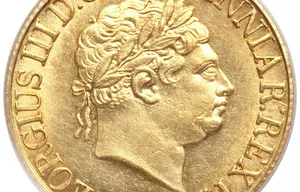
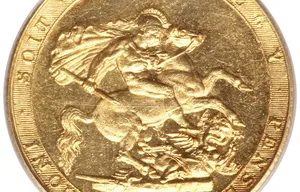
| Sovereign, St George reverse | The hair above the ear, the horse’s flank and rump, St George’s knee |
| Victorian penny | Britannia’s knee and breast, the hair over the ear, the shield lines |
| Pre-1947 shilling or florin | The monarch’s cheekbone and hair, the raised shield detail |
Compare the highest point with a protected area near the rim. If the two look the same, the coin has little wear. If the rim area is sharp and the high point is smooth, the coin has been in circulation.
Hold the coin by its edge, over a soft surface, under a single lamp. Tilt it. Wear and cleaning both show up at an angle and both disappear under flat light, which is why photographs taken on a phone flat on a table tell a buyer nothing.
Lustre, toning and damage
Lustre is the cartwheel sheen of an untouched surface, visible when the coin is tilted under a lamp. It is present on uncirculated coins, fades through EF, and is absent below that. A coin with wear but full lustre has been cleaned or polished, since the two do not occur together, and it is the first thing a buyer checks.
Toning is a chemical film that forms over decades. On silver it runs from pale gold to deep blue and grey. Even, attractive toning adds money. Patchy toning from a PVC album sleeve, which shows as green and sticky, is damage and needs a conservator rather than a cloth.
Corrosion, verdigris and pitting are not grade, they are damage, and they are described separately. A coin can be EF and corroded, and it sells as a damaged coin.
Edge knocks, rim nicks and scratches are also described separately. A single scratch across a field can halve the price of an uncirculated coin.
What cleaning actually does, and how it is spotted
Under magnification a cleaned coin shows fine parallel hairlines running in the direction the cloth moved, concentrated in the open fields where there is nothing to interrupt them. Dipped coins lose their lustre and take on a flat, slightly milky brightness. Harshly cleaned coins show bright metal in the recesses where old toning survived everywhere else, which is the reverse of how a coin ages naturally.
A dealer sees all three across a table. If a coin is dirty, leave it dirty and let the buyer decide.
The only handling that is safe is this: hold by the edge, never touch a face, store in a non-PVC flip, an inert album page or a paper envelope, and keep it dry. If a coin has soil on it from the ground, a rinse in distilled water and a pat dry with a soft cloth is the outer limit, and even that is a decision to take with advice.
Slabbed coins
Third-party grading services seal coins in plastic holders with a numeric grade and a guarantee of authenticity. For valuable coins the holder reassures buyers who cannot handle the coin, widens the market to online bidders, and can raise the price by more than the fee.
The fee is tiered by the coin’s declared value and starts in the £25 to £40 range per coin, before two-way insured carriage and the grader’s own handling charges. Submissions go in batches through a dealer, which spreads the carriage.
The arithmetic is simple. Slabbing pays where the coin is worth several hundred pounds and where the grade is genuinely uncertain at the top end. It does not pay on a common-date sovereign, a worn penny or anything a dealer can grade across a counter. Ask a dealer before paying to slab anything.
What grade does to the price
| Coin | Worn | Extremely fine | Uncirculated |
|---|---|---|---|
| Common-date sovereign | Bullion value | Bullion plus a modest premium | A larger premium, date dependent |
| Scarce-date sovereign | Low hundreds | Four figures | Several thousand |
| Victorian penny, common date | Pence | £20 to £60 | Three figures with full lustre |
| Pre-1920 shilling | Silver value | £15 to £40 | Higher, by date |
Those are the shapes rather than quotations. Which sovereign dates are the scarce ones, and which years hold no sovereign at all, is set out in sovereigns by year. The illustrative price records note a grade against every coin, and the old coins guide covers which coins from a tin are worth grading at all. For the commonest silver coin in a British drawer, the half crown guide sets out which dates reward the grade and which are metal whatever condition they are in.