What the date decides, and what it does not
For most sovereigns the date decides nothing. A worn coin of a common year is a bullion coin and sells within a few percent of its gold, and there are more common years than scarce ones. The date earns its keep in three situations: when it belongs to a short list of scarce years, when it sits beside a scarce mint mark, and when the coin is uncirculated and the year sets how many survive in that condition.
This page is for placing a date. What the placed coin is worth against spot, and what each kind of buyer pays for it, is in the sovereign guide.
Find your date
A period below is the span in which a design was in use, rather than a promise that a sovereign was struck in every one of its years. The years known to be missing are listed in the next section, and a date that sits oddly against both tables wants a catalogue rather than a guess.
| Years | Obverse | Reverse | Mints |
|---|---|---|---|
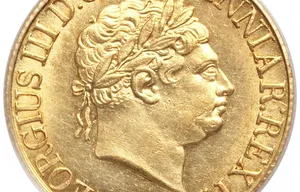
| 1817 to 1820 | George III, laureate head | St George inside the Garter, with its motto | London |
| 1821 to 1825 | George IV, laureate head | St George, Garter removed, a sword in place of the lance | London |
| 1825 to 1830 | George IV, bare head | Crowned royal arms, the Ensigns Armorial | London |
| 1831 to 1837 | William IV | Crowned royal arms, with the word Anno beside the date | London |
| 1838 to 1874 | Victoria young head | Crowned shield inside a wreath | London |
| 1855 to 1870 | Victoria, banksia wreath | Sydney’s own design, reading AUSTRALIA and ONE SOVEREIGN | Sydney |
| 1863 to 1874 | Victoria young head | Shield, with a small die number beneath it | London |
| 1871 to 1887 | Victoria young head | Shield and St George struck side by side | London to 1874, Australia to 1887 |
| 1887 to 1893 | Victoria Jubilee head | St George | London, Australia |
| 1893 to 1901 | Victoria Old Head | St George | London, Australia |
| 1902 to 1910 | Edward VII | St George | London, Australia, Ottawa from 1908 |
| 1911 to 1932 | George V | St George | London, Australia, Ottawa, Bombay, Pretoria |
| 1937 | Edward VIII, then George VI | St George | London, neither for sale |
| 1953 | Elizabeth II, Gillick | St George | London, not for sale |
| 1957 to 1968 | Elizabeth II, Gillick | St George | London |
| 1974 to 1984 | Elizabeth II, Machin | St George | Tower Hill to 1975, then Llantrisant |
| 1985 to 1997 | Elizabeth II, Maklouf | St George | Llantrisant |
| 1989 | Elizabeth II enthroned | Crowned arms on a Tudor rose | Llantrisant |
| 1998 to 2015 | Elizabeth II, Rank-Broadley | St George, with other reverses in 2002, 2005 and 2012 | Llantrisant, India from 2013 |
| 2015 to 2022 | Elizabeth II, Clark | St George, royal arms in 2022 | Llantrisant, India |
| 2022 onwards | Charles III, Jennings | Royal arms in 2022, St George after it | Llantrisant |
Two rows of that table do most of the work in practice. The 1911 to 1932 George V sovereigns are the commonest in the series and the ones that arrive in bank bags and house clearances. Further up, a shield in place of St George puts a coin between 1838 and 1874, and that is the sovereign readers take for damaged or foreign, because a sovereign with no dragon on the back looks wrong to anyone who has only handled a modern one.
The years with no sovereign, and the one with almost none
A date that does not exist is the quickest thing to rule out, and the list is longer than most price guides admit.
| Years | What happened |
|---|---|
| 1819 | 3,574 struck, against 2,347,230 the year before, because the public preferred the banknotes the coin had been meant to replace. One of the rarest British coins of any metal |
| 1840 and 1867 | London struck no shield sovereign in either year |
| 1882 | The London mint was being rebuilt and coined no sovereigns for about a year |
| 1912 and 1915 | Ottawa struck none in either year, having struck every other year from 1908 to 1919 |
| 1918 to 1924 | London struck none. It coined sovereigns to the end of 1917 and then stopped |
| 1926 to 1956 | London struck none for circulation. The exceptions are the 1925-dated coins below, the 1937 proofs and the 1953 pieces |
| 1960, 1961 and 1969 to 1973 | No sovereigns were struck at all |
| 1983 to 1999 | Proofs only. No bullion sovereign carries a date in this range |
The last of those catches people out. Bullion striking was suspended after 1982 and did not resume until 2000, so a sovereign dated 1991 or 1996 came out of a collector’s set rather than a dealer’s tube, and it is worth handling as a proof rather than rubbing the date clean to read it.
Pretoria’s 1932 sovereigns were the last struck anywhere to be issued as currency at face value.
The 1925 sovereigns struck in 1949
Britain returned to the gold standard under the Gold Standard Act 1925, and some lightweight sovereigns were melted and restruck with that date. The Royal Mint then struck more 1925-dated sovereigns in 1949, 1951 and 1952, partly to meet demand from the Middle East and partly to keep the skill of striking them alive at the mint.
Before those restrikes, an original 1925 London sovereign was a coin only a few people had seen. Afterwards it was a common date, and its price fell to match. A 1925 sovereign is a bullion coin unless a specialist says otherwise, which is the reverse of what its mintage figures on their own suggest.
Two dates that were never sold
Sovereigns dated 1937 exist for two kings. Edward VIII’s was prepared for the traditional coronation proof set, was never authorised by royal proclamation before his abdication that December, and counts as a pattern. George VI’s 1937 proof sovereigns are the only ones to carry his head. Neither was ever offered to the public.
The 1953 Elizabeth II sovereign, with Mary Gillick’s portrait, went to the major museums and nowhere else.
So a 1937 or 1953 sovereign offered privately, in a mount or through an online listing is a coin to have examined before any money moves. The half sovereign guide covers the same two years in the smaller coin, where the pattern repeats exactly.
Reading the exergue before the date
The mint mark is a single letter below the dragon, in the strip of ground called the exergue, or below the shield on a shield reverse. It changes what a year means, because a date that ran to millions in London ran to a few thousand somewhere else in the same twelve months.
| Mark | Mint | Sovereign years |
|---|---|---|
| S | Sydney | 1855 to 1926 |
| M | Melbourne | 1872 to 1931 |
| P | Perth | 1899 to 1931 |
| C | Ottawa | 1908 to 1919, none in 1912 or 1915 |
| I | Bombay | 1918, and India again from 2013 |
| SA | Pretoria | 1923 to 1932 |
The I mark reads two ways, seventy-five years apart. Bombay struck sovereigns for one year in 1918. Since 2013 sovereigns have been struck in India again under licence from the Royal Mint, and those coins are legal tender in the United Kingdom, so an I sovereign dated after 2012 is a current bullion coin rather than a 1918 rarity.
Three dates beyond the list of gaps are worth a catalogue check on sight: the 1819, the 1863 London sovereign carrying the number 827 on the obverse where William Wyon’s initials belong, and the 1879 London sovereign, of which few were struck and the survivors are mostly well worn.
What the year was struck for
From 1979 the sovereign was sold as a bullion coin and struck as a proof for collectors in the same years, and the proof issue has run annually since. That split is the last thing to establish about a date.
| Purpose | Years |
|---|---|
| Currency, to spend | 1817 to 1932 |
| Reserves and the trade rather than change | 1925, and the 1925-dated coins struck from 1949 to 1952 |
| Bullion, sold by the Royal Mint | 1957 to 1959, 1962 to 1968, 1974 to 1982, and 2000 onwards |
| Proof, sold to collectors | 1979 onwards, and the only issue from 1983 to 1999 |
Sovereigns struck for 2026 carry security features that no earlier date has: the motto of the Order of the Garter set as a legend around the reverse, and an optical security image on the obverse. The 2026 range also returns to yellow gold from the rose tone of the preceding years, which came from a higher proportion of copper in the alloy. Both changes appear on the bullion coins, and both are a way of dating a recent sovereign across a table.
Where the date stops mattering
Reading the date is the second job, not the first. A sovereign of any year holds 7.32 grams of fine gold, and that gold is the floor under the coin whatever the reverse says, so weigh it and do the arithmetic before looking anything up. The Royal Mint publishes the specification the weight is judged against.
Once the date is placed, condition decides the rest for every year outside the short lists above. The grading guide sets out where wear shows on a St George reverse, and the price records set each hammer price beside the estimate the saleroom gave it, as illustrative figures until the saleroom feeds land. A date and a grade together are a question a dealer can answer in a sentence. A date on its own is not.