What one holds
A half sovereign contains 3.66 grams of fine gold. At the London benchmark price of £3,233.67 a troy ounce on 21 September 2026, that gold was worth £381, and £381 was the floor under every half sovereign struck since 1817. A worn coin of a common date sells within a few percent of the floor.
The coins that sell for more are a short list, and the back of the coin narrows that list before the date does.
The shield reverse, and what 1893 changed
The half sovereign carried a shield for its first seventy-six years. Benedetto Pistrucci’s St George and the dragon went on the sovereign in 1817 and did not reach the half sovereign until 1893, so the reverse splits the series cleanly in two.
| Reverse | Years | What it places the coin as |
|---|---|---|
| Crowned shield, garnished in several styles | 1817 to 1893 | Georgian, William IV or Victorian shield type |
| St George and the dragon | 1893 onwards | Old Head Victoria or later |
A shield on the back of a half sovereign means a coin struck before 1893, whatever a price list written for sovereigns says. The sovereign moved the other way round, losing St George in 1825 and regaining him in 1871, so the two coins cannot be dated by the same rule. Turn a half sovereign over before reading anything else about it.
1893 is the single year that carries both, because Thomas Brock’s Old Head obverse and the St George reverse arrived together part way through it. Modern collector issues break the rule as well: 1989, 2002 and 2022 carry royal arms or a crowned shield in place of St George, and on those the date is plain enough to read without the reverse.
The obverse then gives the reign.
| Obverse | Years struck |
|---|---|
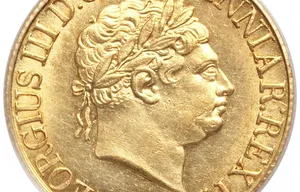
| George III, laureate head | 1817, 1818 and 1820 |
| George IV, Pistrucci bust | 1821, then 1823 to 1825 |
| George IV, Wyon bare head | 1825 to 1828 |
| William IV | 1831 as a proof, then 1834 to 1837 |
| Victoria young head | 1838 to 1886 |
| Victoria Jubilee head | 1887 to 1893 |
| Victoria Old Head | 1893 to 1901 |
| Edward VII | 1902 to 1910 |
| George V | 1911 to 1915 at London, to 1926 at the branch mints |
| George VI | 1937 only |
| Elizabeth II | 1953, then 1980 to 2022 |
| Charles III | 2022 onwards |
The arithmetic, at any gold price
Three numbers give the answer: 3.661 grams of fine gold, the gold price per troy ounce, and the date you are asking on. Divide the per-ounce price by 31.1035 for the price per gram, then multiply by 3.661.
| Gold, per gram fine | Half sovereign | Sovereign |
|---|---|---|
| £90 | £329 | £659 |
| £100 | £366 | £732 |
| £104 | £381 | £761 |
| £110 | £403 | £805 |
| £120 | £439 | £879 |
Gold has moved a long way in five years, so a figure quoted in an older guide is a starting point for the arithmetic rather than an answer. The £104 row is the London benchmark of 21 September 2026, rounded.
The specification behind the arithmetic comes from the Royal Mint, which strikes the coin to 3.99 grams gross, 916.7 fineness and 19.30 mm across. Weight is the first test on any half sovereign, and a jeweller’s scale reading to 0.01 grams settles most questions before a loupe comes out.
Why a half sovereign trails half a sovereign
Two half sovereigns hold the same gold as one sovereign and fetch less than one sovereign between them. Cost rather than metal explains it. A mint spends nearly as much striking a small coin as a large one, and the minutes a dealer puts into authenticating, weighing and packing one are the same either way, so a fixed cost lands on half the quantity of gold. The gap between what a dealer pays and what a dealer charges is a wider percentage on the half sovereign at every stage of the trade.
Price the sovereigns and the half sovereigns in a lot separately, because the halves will come back at a lower percentage of spot.
The Royal Mint found the same thing in the nineteenth century from the other direction. Exacting standards meant that 45 per cent of newly struck half sovereigns were rejected and melted at the mint, which made it the most expensive coin in the world to produce and nearly got it abolished in the 1880s. Lord Randolph Churchill, as chancellor, called it “that profligate little coin”.
The dates that are not bullion coins
| Date | Why it gets checked |
|---|---|
| 1817, 1818 and 1820 | The first three years of issue. No half sovereign is dated 1819 or 1822 |
| 1829 | The 1829 striking was dated 1828. One coin dated 1829 exists, in the Ashmolean, struck by the Royal Mint in 1891 from the original dies |
| 1834 | Struck at 17.9 mm, narrower than the rest of the series. £60,000 of them, 120,000 coins, were recalled for resembling the discontinued seven shilling piece |
| 1881 and 1882 | London struck none, the mint being rebuilt in the second year |
| 1888 | No mint struck a half sovereign at all. Only Sydney struck them in 1889 |
| 1918 P | Perth holds no record of striking half sovereigns that year. Few are known |
| 1923 SA | Pretoria, proof only |
| 1937 | George VI, proof only, from the coronation set, with a plain edge |
| 1953 | Elizabeth II, struck for the royal and national collections and never offered for sale |
The 1937 and 1953 coins matter to a reader for a reason that has nothing to do with price. Neither was sold to the public, so a half sovereign of either date arriving through a private offer or an online listing wants an expert opinion before money moves. The full sovereign has the same two years and the same problem, set out with the rest of the series in the sovereign dates guide.
Everything not in the table above, and not carrying a scarce mint mark, is a bullion coin. Half sovereigns of 1982 and later were struck for sale by the Royal Mint in quantity, and no year of Elizabeth II or Charles III is scarce.
The mint mark that never appears on a half sovereign
On a St George reverse the mark sits in the exergue, the strip of ground below the dragon and above the date. On a shield reverse it sits below the shield.
| Mark | Mint | Half sovereigns |
|---|---|---|
| None | London | 1817 to 1915, and 1980 onwards |
| S | Sydney | From 1855. Its own Australian design to 1866, the London design from 1871 |
| M | Melbourne | From 1873 |
| P | Perth | From 1900 |
| SA | Pretoria | 1923, 1925 and 1926 only |
| I | India | 2014 |
| C | Ottawa | None |
Ottawa is the trap. It struck sovereigns with a C from 1908 to 1919 and never struck a half sovereign, so a C on a small gold coin is a reason to weigh the coin again rather than a rare date. The Australian mints stopped striking half sovereigns in 1920, with only a few made after 1916 and those at Perth. Pretoria’s 1925 and 1926 coins, struck because mine owners insisted on paying wages in gold, were the last half sovereigns made for circulation anywhere.
The gilded sixpence
The silver sixpence and the half sovereign were close enough in size that gilding a sixpence and passing it as gold was a standing fraud for a century, and the Royal Mint twice redesigned a coin because of it. George IV’s first half sovereign reverse of 1821 was withdrawn for resembling the sixpence. The 1887 Jubilee sixpence, which carried no written denomination, was withdrawn after a wave of gilding. From William IV’s reign the sixpence carried a statement of its value for the same reason.
The test is the scale. A half sovereign weighs 3.99 grams and a pre-1920 sixpence weighs 2.83 grams, and gold leaf does not close a gap of more than a gram.
A mount is the other thing that changes the answer. A half sovereign soldered into a pendant, ring or bracelet, or drilled for a chain, has lost the surface a collector pays for, and it is priced as gold by weight from that point on. A scarce date in a mount is a common coin as far as the figure goes.
Before anyone quotes you a figure
Weight, reverse, date, in that order. Weigh the coin to 0.01 grams and compare it with 3.99. Turn it over and see whether the back carries a shield or St George, which places it either side of 1893. Then read the date against the tables above, and read the grading guide before deciding what condition it is in, because wear on a St George reverse shows first on the horse’s rump and St George’s knee.
Bullion dealers quote sovereigns and half sovereigns per coin. Ask for a figure per coin, count the coins in front of the person offering it, and treat a single price for a bagful as a starting position. What each kind of buyer pays against spot is set out in the sovereign guide, and the price records set each hammer price beside the estimate the saleroom gave it, as illustrative figures until the saleroom feeds land.