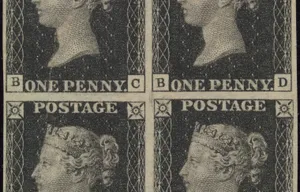
Most Penny Reds are worth pennies
The Penny Red ran for 38 years and was printed from more than 400 plates, against the Penny Black’s nine months and eleven. About 21 billion were made, which is why a used one lifted off an envelope is worth 10p to £5, on the illustrative ranges set out below, and why a hundred of them are one lot.
Penny Red stamp value is decided in two steps. First, which of the three issues you are holding, which the edges and the upper corners of the stamp settle in a few seconds. Second, the plate number, engraved into the design from 1864, which is the only feature that lifts a common stamp out of that range.
The three Penny Reds, and how to tell which you have
Turn the stamp face up and look at the edge and then the top two corners.
| Issue | Years | Edges | Upper corners |
|---|---|---|---|
| Imperforate | 1841 to 1854 | No perforations. Cut from the sheet with scissors | Stars |
| Perforated stars | 1854 to 1864 | Perforated, gauge 16 and then gauge 14 | Stars |
| Plate numbers | 1864 to 1879 | Perforated, gauge 14 | Check letters, reversed from the pair below |
The divisions are not a collector’s invention. The Postal Museum arranges the R M Phillips Collection on the same lines, with separate volumes for the imperforate 1d red, for the perforation 16 and perforation 14 stamps, and for the 1864 stamps inscribed with plate numbers.
The check letters in the lower corners give the stamp’s position on a sheet of 240, running A-A to A-L across twelve columns and down twenty rows to T-L. No pair is worth more than another. Their use is to fix a stamp to a position on a named plate, which is what the trade calls plating, and it is also what makes a stolen one traceable.
What each issue is worth
| What you have | Illustrative range, used |
|---|---|
| Plate number issue, 1864 to 1879, common plate | 10p to 30p |
| Perforated stars, 1854 to 1864 | 30p to £10 |
| Imperforate, 1841 to 1854, margins cut into the design | 50p to £2 |
| Imperforate with four clear margins | £3 to £8 |
| Any issue, unused with original gum | Several times the used figure, and it needs a certificate |
| A scarce plate, plated and in fine condition | Hundreds, and occasionally thousands |
These are illustrative ranges for sound stamps. A thin, a tear, a crease or a heavy cancel across the head takes most of the figure off, and the tests for those are the same ones the Penny Black guide sets out.
The top of that last row is the reason to read the side frames. The price records carry a Penny Red from plate 225, the last plate put to press, which sold for £2,100 against an estimate of £1,500 to £2,500. That row is illustrative rather than a particular sale, and a common plate in the same design is worth 20p.
What changed between 1841 and 1879
Ten dates run through the Penny Red’s 38 years, and each one narrows the date of a stamp that carries its change.
| Date | Change |
|---|---|
| February 1841 | The 1d changes from black to red-brown, printed at first from the Penny Black plates |
| 1844 | The Maltese cross obliterator gives way to barred numerals that code the office of posting |
| 1848 to 1850 | Henry Archer’s separation trials: rouletting first, then an experimental perforation at gauge 16 |
| 24 February 1854 | Perforation at gauge 16 adopted for the general issue |
| January 1855 | Perforation reduced from gauge 16 to gauge 14, because the sheets were coming apart in handling |
| 15 May 1855 | Watermark changed from small crown to large crown |
| 1857 | The colour moves to rose-red and a second die comes into use |
| 1861 | A fourth alphabet for the check letters, on plates 50 and 51 |
| 1 April 1864 | Letters in all four corners, and the plate number engraved in the side frames, from plate 71 onwards |
| 27 October 1879 | Plate 225, the last plate, put to press. Perkins Bacon’s contract ended that December |
The rose-red, die and alphabet rows are dated from the Phillips volumes above, which group the stamps by exactly those divisions. The Penny Venetian Red replaced the issue in 1880 and lasted a little over a year, which makes an 1880 penny stamp a different stamp with a different value.
Two of those dates do the most work. Letters in all four corners put a stamp after April 1864. A star above a perforated edge narrows it to the decade from 1854, unless it is one of the scarce Archer trial perforations of 1850 to 1853, which a specialist separates by the alphabet used for the check letters.
Plate 77, and why yours is plate 177
Plate 77 was made and then refused registration, because the impressions were laid down out of alignment and the perforations would have cut into the stamps. One sheet appears to have been printed, and it should have been destroyed.
Spink’s published survey of the plate counts eight single stamps and traces the history of each. Two sit in the British Library, one of them from the Tapling Collection bequeathed in 1891, which the library still shows in its philatelic gallery. King George V bought a third in 1919 and it is in the Royal Collection. Of the rest, one burned in the fire that followed the San Francisco earthquake of 1906, another was stolen in 1965 and has never resurfaced, and the two that have changed hands this century went by private sale arranged by a dealer rather than under a hammer, so no saleroom result for a plate 77 exists to quote.
The last one found by a collector sorting through stamps turned up in 1944, and that is the useful part. Plate 177 was in ordinary use and its stamps are common. The plate number sits in the lacework at the side of the design, where the obliterator crosses it, and a cancel over the first digit of 177 leaves 77.
A genuine candidate goes to the expert committee of the Royal Philatelic Society London for a certificate. The certificate comes first and the figure comes after it, which is the reverse of the order most people expect.
The cancel names the post office
From 1844 the Maltese cross was replaced by barred numeral obliterators, and the number inside the bars codes the office where the letter was posted. England, Scotland and Ireland each had their own pattern of bars.
For a common plate-number stamp that number is where the money is. Postal history collectors buy the mark rather than the stamp, and an office that closed early or handled little mail is worth more than the 20p the stamp is worth. The first day covers guide sets out what those buyers read on an envelope.
So do not soak a Penny Red off its cover. The envelope carries the date, the route and the arrival marks, and it is worth more intact than the stamp is worth loose.
What a run of them is worth together
Penny Reds are collected by plate, which is why a run of the numbers 71 to 225 sells as a collection while a heap of duplicates sells by weight. Some numbers inside that range were prepared and then rejected and never reached ordinary issue, plate 77 among them, so a run with holes in it is not necessarily missing anything a collector could buy. The gaps that count are the scarce issued plates, and the last few numbers are the hardest to fill.
So count the plate numbers before deciding anything. Write down which of the 71 to 225 you hold, with the ones you cannot read marked as unread rather than guessed, and photograph the side frames of those at high magnification in daylight. That list is what a specialist prices, and where to sell a stamp collection sets out what each buyer will pay for it.