Weight sets the floor, the pattern and the name set the rest
The price of sterling silverware begins with its weight, because every solid piece has a metal floor and nothing sells below it. A canteen of silver cutlery for six, with the knives set aside, runs 1,800 to 2,600 grams, which the trade quotes as roughly 58 to 84 troy ounces, and the scrap calculator turns that into today’s figure in a line. Put the weight in first, then read the mark, then look at the pattern. Those three in that order account for almost every price a saleroom puts on a service.
Above the floor, two things lift a piece. The first is the name struck on the back, which is worth more than the metal on a small object and worth nothing on a plain modern one. The second is the pattern, because a heavy pattern holds more silver per piece and the collected ones sell as complete services rather than as weight.
What silver cutlery and silverware make at auction
These rows come from the price records and are illustrative rather than particular sales. Each figure is a hammer price, before the buyer’s premium.
| Lot | Estimate | Hammer |
|---|---|---|
| Georg Jensen Acorn canteen, 48 pieces | £1,500 to £2,500 | £2,100 |
| Omar Ramsden footed bowl, London 1928 | £1,200 to £1,800 | £2,600 |
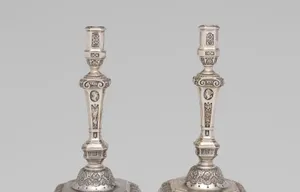
| Pair of George III candlesticks, Sheffield 1791 | £600 to £900 | £720 |
| Silver tankard, London 1772, later chased | £300 to £500 | £320 |
| Georg Jensen Pyramid dessert spoons, set of six | £150 to £250 | £190 |
| Victorian bachelor’s teapot, Birmingham 1889 | £150 to £250 | £180 |
| Hester Bateman sugar tongs, London 1786 | £80 to £120 | £110 |
| Set of six sterling teaspoons with an EPNS tray, mixed | £40 to £60 | £40 |
Two rows carry the lesson of the table. The Jensen canteen sold as a design, in the pattern Johan Rohde drew in 1915, and the Jensen page explains why a pre-war mark on the same service is worth more than a post-war one. The six teaspoons with a plated tray sold at the bottom of a £40 to £60 estimate, because mixed spoons are weight and the tray was not silver at all.
The pieces that do not weigh what they look like
A gross weight taken off the kitchen scales overstates what a service is worth, and three kinds of piece are responsible.
Table knives are the largest error. A silver-handled knife is a stamped silver shell on a steel blade, filled to hold the two together. The V&A’s King’s pattern table knife by D. and J. Wellby, hallmarked in London in 1894, is catalogued exactly that way: silver handle, steel blade. A dozen knives add several hundred grams to the scale, most of it filler and steel, so they are weighed and quoted on their own rather than counted into the canteen’s weight.
Loaded pieces come next. Candlesticks, some vase forms and the bases of trophies are a thin silver shell filled with resin and weighted with plaster, and the silver is 15 to 25 percent of what the scale shows. The scrap or auction guide carries working weights for loaded candlesticks and photograph frames.
Then there is everything on a piece that was never metal. Bone, wood and ivory insulators on a teapot handle, glass liners in salts and mustard pots, and the steel in a pair of grape scissors all come off before a refiner quotes. Ivory brings a further problem, because an item containing ivory from a species listed in the Ivory Act 2018 cannot be offered for sale in the UK unless it is registered or certified as exempt, which the selling guide sets out.
Fiddle, Old English and King’s: reading the pattern
The pattern is the shape of the handle, and it is the first thing a specialist names because it decides whether the pieces can be matched.
| Pattern | How to recognise it | What it means for the price |
|---|---|---|
| Old English | Plain handle, no shoulders, the tip turning down so the piece lies bowl uppermost | Plentiful, light, and the eighteenth-century examples sell on the maker |
| Old English bright-cut | The same handle with engraving round the edge cut in facets, so the border catches the light | The engraving wears off with polishing, and a worn one is weight |
| Fiddle | Flat handle with shoulders where the stem meets the bowl or the tines, the outline of a violin | The commonest nineteenth-century pattern, and the cheapest to complete |
| Fiddle, thread and shell | Fiddle with a raised line round the edge and a shell at the finial | Heavier than plain Fiddle, and matching pieces are harder to find |
| King’s | A scroll running down the handle to a shell at the tip, and noticeably heavy in the hand. The better ones are struck on both faces | The dearest of the standard patterns, then and now |
| Queen’s | The King’s outline with a differently cut shell at the tip, which a specialist names on sight | Priced with King’s, and the two will not match each other in one service |
The V&A dates the turned-down handle to the trade’s own language: Garrard’s records for 1760 list customer orders for spoons and forks described as “turn’d back”, meaning the finial turns down so that the piece can be laid on the table with the bowl uppermost, and that shape came to be called Old English. Bright-cut engraving, faceted rather than lined, arrives around 1770. The museum’s record for that spoon calls its border a feather edge and notes that eighteenth-century account books described the feature as “laurelling”, which is a warning about the words rather than the object: the same edge is catalogued under more than one name, so describe what you can see rather than naming a pattern you are unsure of.
King’s pattern cost more when it was new and it costs more now. The V&A’s gallery label for the Wellby knife records that a dozen silver table forks in King’s pattern could cost £8 in 1896, against £5 12s 6d for a dozen in Fiddle from the Goldsmiths and Silversmiths Company. That gap is the weight of silver and the depth of the die work, and it survives into the saleroom. Queen’s, the close variant, is recorded in the museum’s catalogue for a George Adams fork of about 1860 as first known about 1825.
Matching a service is the reason the pattern matters more than the name of it. James Dixon and Sons offered 28 different cutlery designs in their catalogue of 1892, by the museum’s count, and Dixon was one firm among many in Sheffield. Finding six dessert forks in the right pattern, at the right size and from a period that matches the rest, is a year of watching sales, and that is why a complete service sells for more than its pieces. The Sheffield page names the firms whose flatware turns up most.
Sterling or plate, and why the canteen in the sideboard is plate
Most inherited silver is plated, which the six tests guide says in its opening line, and a boxed canteen is no exception. The letters to look for are EPNS, EP, A1 and EPBM, and none of them is a hallmark: they are a manufacturer’s description of a silver skin on base metal, and the EPNS page explains what each one claims. A plated service of any size is worth pounds rather than hundreds, and the exceptions are a named pattern in perfect condition and Old Sheffield plate, which predates electroplating.
A sterling service carries four punches on every piece, and reading the row takes a minute with the hallmarks guide. More than one date letter in a box is not by itself a composite, because a large order can run across two hallmarking years. What makes a composite is more than one maker, or pieces from different decades, in the same pattern. Where the punches are worn flat by decades of polishing, the service loses the maker and the date and sells nearer its metal, which is the cost of a well-kept sideboard.
Continental flatware reads differently again. A German service states a fineness in numbers, 800 or 835 rather than 925, while a number such as 90 is a plating figure rather than a fineness and puts the service in the plated pile, which the German entry sets out.
What an incomplete service is worth
A complete canteen by a known maker, in its original box, sells for more than the same pieces sold loose. The reverse case is a composite service, assembled over years from different makers and dates in the same pattern, and it sells as weight plus a little for the pattern.
Three faults drop a service towards its floor. Pieces from more than one pattern in one box turn the lot into scrap with a few sets inside it. A crest or a monogram that has been ground off leaves a thin patch that shows against the light. Bent tines, split bowls and knife blades that have been replaced in stainless steel each cost more to put right than the piece is worth.
A service of twelve in one pattern by one maker, with the servers and the original box, is worth a specialist’s time. A drawer of odd spoons and forks with no two alike goes to the refiner.
What to do with the canteen on the table
Weigh everything except the knives, write the figure down, and put it into the scrap calculator for the floor. The selling guide sets out which of the three weights a buyer’s quote refers to. Count the pieces by type and note the pattern and the date letter from any one of them. Photograph the marks on a spoon and the whole service laid out.
That single sheet of paper is what a saleroom needs to give an opinion, and it is also what tells you whether the opinion is worth asking for. Two thousand grams of sterling in one pattern, with a maker’s mark you can read, earns a specialist’s attention. A box of mixed plate has cost you twenty minutes and saved you a wasted journey.