
Maker · silver
Paul Storr
The most collected English silversmith of the Regency. Storr's grand neoclassical hollowware for Rundell, Bridge and Rundell set the standard for the period, and his mark multiplies a price.
- Mark
- PS in a rectangle
- Active
- 1792 to 1838
- Place
- London
- Typical range
- £600 to £25,000 and beyond for important pieces
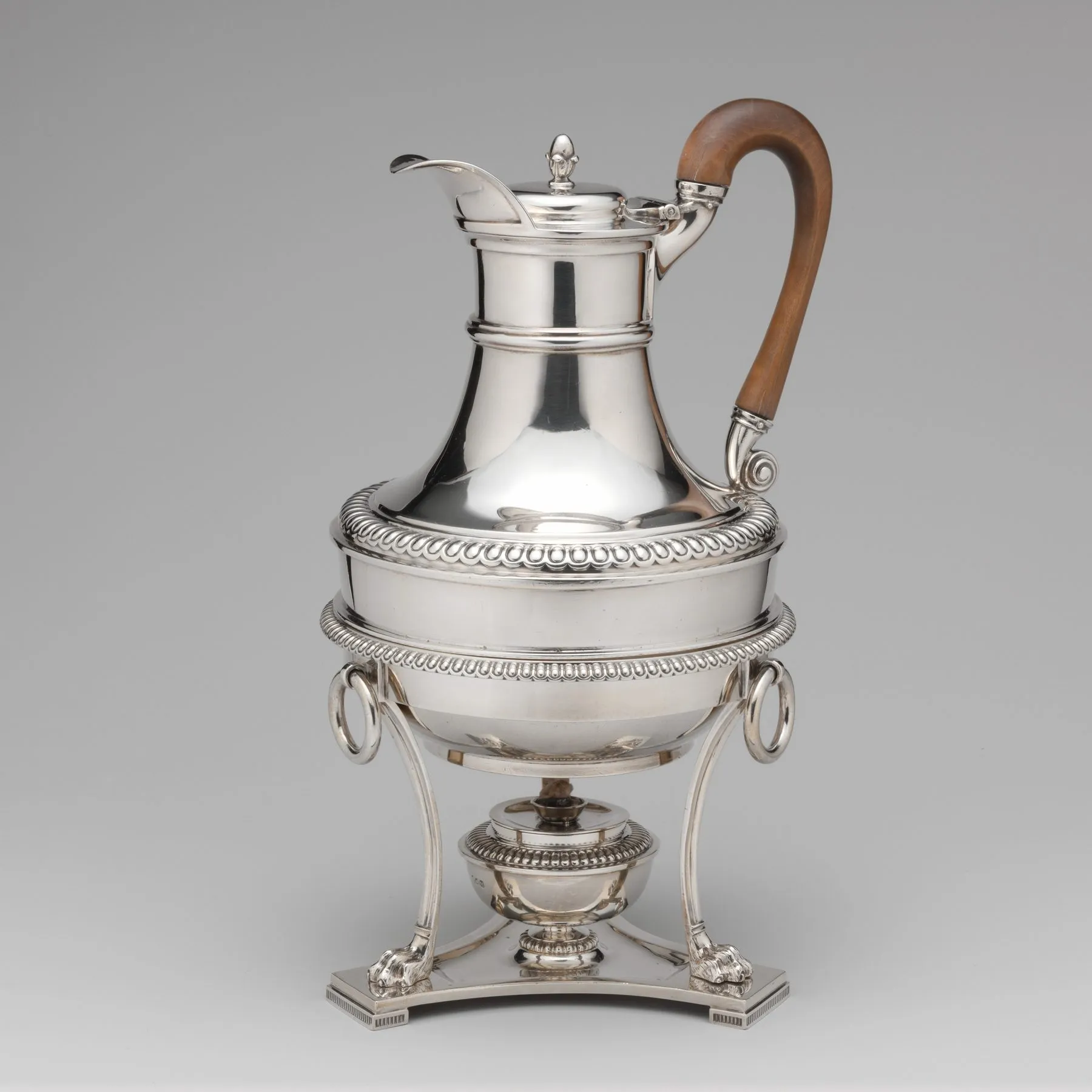
The Metropolitan Museum of Art, open access
Paul Storr was born in 1771, apprenticed to the Swedish-born silversmith Andrew Fogelberg, and registered his first mark in 1792. From 1807 he worked for the royal goldsmiths Rundell, Bridge and Rundell, whose workshop produced the largest commissions of the age: services for the Prince Regent, presentation plate, racing trophies and the enormous wine coolers that still surface at auction. He left Rundell’s in 1819, worked with John Mortimer from 1822, and retired in 1838. He died in 1844.
What to look for
His mark is PS in a rectangle with cut corners, struck alongside the leopard’s head, lion passant, date letter and the sovereign’s head duty mark. On Rundell’s pieces the Latin inscription “Rundell Bridge et Rundell aurifices regis et principis Walliae Londini fecerunt” is engraved under the base.
The style is Regency neoclassicism at full weight: gadrooned borders, acanthus, lion’s paw feet, and cast and applied ornament rather than thin chased decoration. Pieces are heavy. A Storr teapot weighs twice what a provincial one of the same size does.
What moves the price
Weight and scale, the presence of the Rundell’s inscription, an armorial that can be traced to a known commission, and condition of the cast ornament. Later replacement handles and re-gilding lower the figure. Pairs and sets carry a premium over the sum of their parts. Flatware by Storr, which exists in quantity, sells for far less than hollowware and is where a new collector can start.